Support Al Nahda
↑
Support Al Nahda
↑

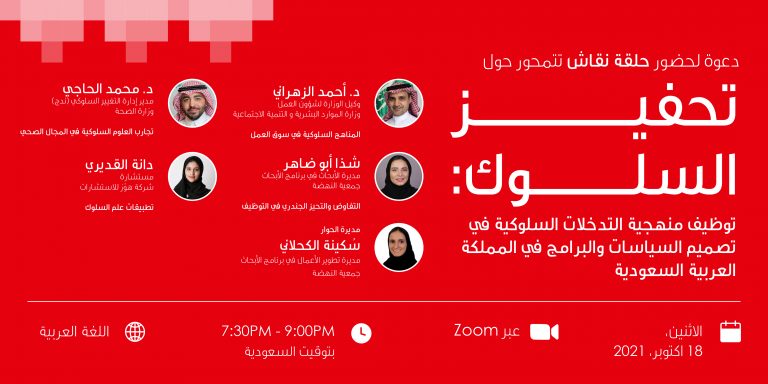
Al-Nahda held a discussion session on Behavioral Motivation, aiming to apply behavioral intervention methodologies in the design of policies and programs in the Kingdom of Saudi Arabia. This session is part of the Speakers Series launched by Al-Nahda Society in 2019, and it represents the third session of 2021. The meeting featured a distinguished panel of speakers from the Ministry of Human Resources and Social Development, the Ministry of Health, Al-Nahda Society, and Howz Consulting.
The session began with a welcome speech by Ms. Sakina Al-Kahlani, who introduced Dr. Ahmed Al-Zahrani. He spoke about behavioral approaches in the labor market, providing an overview of behavioral methodologies and their initial application in public policies in Saudi Arabia’s labor market. He also discussed the Behavioral Policy Network managed by the Riyadh Center for Behavioral Policies and highlighted the role of the Ministry of Human Resources and Social Development in the BI network.
Following him, Ms. Shaza Abu Daher focused on negotiation and gender bias in employment, presenting results from an initiative that assessed employers’ gender bias toward candidates during job offer negotiations. This initiative is part of the Takaful Program, conducted by Al-Nahda’s Research Program in collaboration with the Riyadh Center for Behavioral Approaches in Labor Market Policies at the Ministry of Human Resources and Social Development and the General Organization for Social Insurance.
Dr. Mohammed Al-Hajji then discussed experiences in applying behavioral sciences in the healthcare field, detailing the methodology and management of the Behavioral Change Team at the Ministry of Health. He shared several studies conducted by the Behavioral Change Department, including the automatic intervention for booking appointments in Child Wellness Clinics, and explained when behavioral interventions can be applied to achieve desired outcomes.
Finally, Ms. Dana Al-Qudairi addressed applications of behavioral science, focusing on how individuals make decisions. She presented Howz Consulting’s approach and methodology for designing behavioral solutions and shared examples, including a project on healthy marriage – the “Genetic Compatibility Program for Bearing Healthy Children Free of Genetic Diseases.” She emphasized the importance of understanding beneficiaries’ behavior to design effective programs and policies.
In conclusion, sincere thanks were extended to all speakers and participants for contributing to the success of this dialogue. The positive impact of the session supports Al-Nahda’s Research Program, which in turn enhances the Society’s ability to deliver its mission efficiently by improving the design of policies and programs targeting women and the wider community.